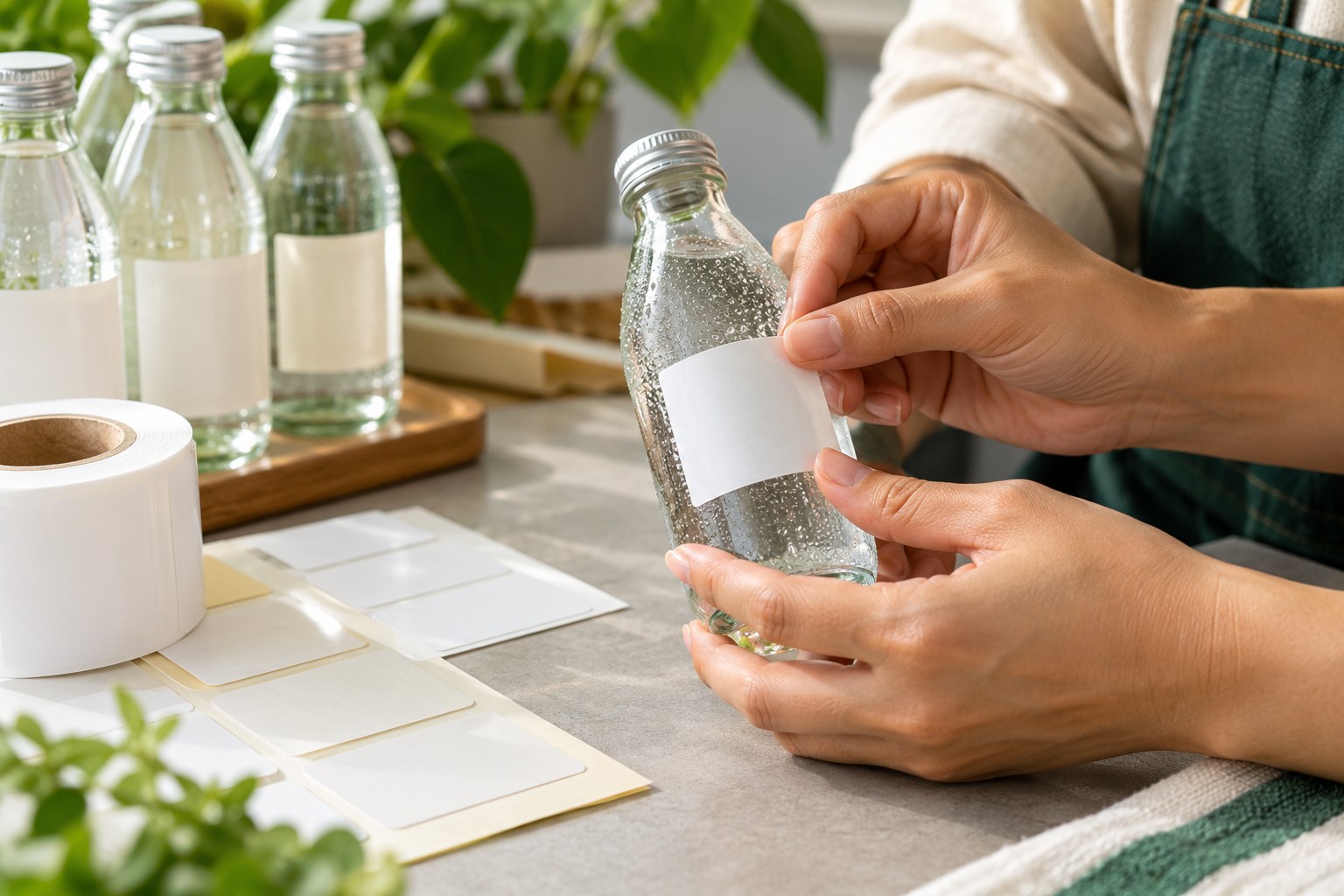
Choosing between paper and PP stickers starts with how the product will be used. A label on a dry-stored box faces different moisture and friction from a refrigerated bottle label. The face material is only part of the decision: adhesive, ink and the packaging surface also matter.
When should you consider paper stickers?
Paper labels offer a range of surfaces and decorative finishes. They are a useful starting point for comparing options for boxes and products used in dry conditions. Check colour samples, surface smoothness and suitability for your actual labelling method. For frequent water or moisture exposure, ask about the properties of the specific grade.
What is PP, and what else should you check?
PP stands for polypropylene, a film material used for labels. The performance of a finished label also depends on its printing system and adhesive. Choosing a film face material does not guarantee that every label can withstand immersion or refrigeration under the same conditions.
Compare the actual conditions of use
| Factor | Questions before ordering |
|---|---|
| Environment | Will it be dry, steamy, exposed to splashes or refrigerated? |
| Packaging | Is the surface glass, plastic, paper or a particular coating? |
| Shape | Is the surface flat, curved or a squeezable bottle? |
| Friction | How much contact will it have with hands, shelves or other products in transit? |
| Application | Will labels be applied by hand or machine, and supplied as sheets or rolls? |
Adhesive and label size matter too
Before a large production run, test the label on the actual container model. Look for lifting edges and air bubbles, and ask about the adhesive’s application conditions. Adjust the size and shape to suit curved surfaces or seams. Do not choose dimensions from a screen image without trying them on the product.
Clean and prepare the surface according to the material supplier’s instructions. Do not assume the adhesive is faulty after applying it to oily, dusty or damp surfaces. Some applications need specialised adhesives, so describe the conditions in advance.
How to test a sample
- Apply it to the actual container and allow the adhesive to set as instructed.
- Test the conditions the product will encounter, including moisture and temperature.
- Check colour, ink, face material, edges and adhesion.
- Record the sample specifications and test conditions for comparison.
- Report the results to the printer before confirming production specifications.
Frequently asked questions
Are water-resistant and waterproof the same?
Ask for the test conditions instead of deciding from the wording alone. Brief splashes and continuous immersion are different conditions of use.
Are film labels always more expensive?
Price depends on material grade, dimensions, quantity, colours, finishes and sheet or roll layout. Request a quotation based on the complete specifications rather than comparing material names alone.
Material reference: Avery on water resistance by label material and printing system. Confirm your final choice with samples of the actual production specification.
Discuss labels and stickers with Phunporn
Send photographs of the container, label dimensions, quantities and conditions of use through our contact channels, or call 096-329-5356. Read more about print-ready artwork and a complete quotation request.